
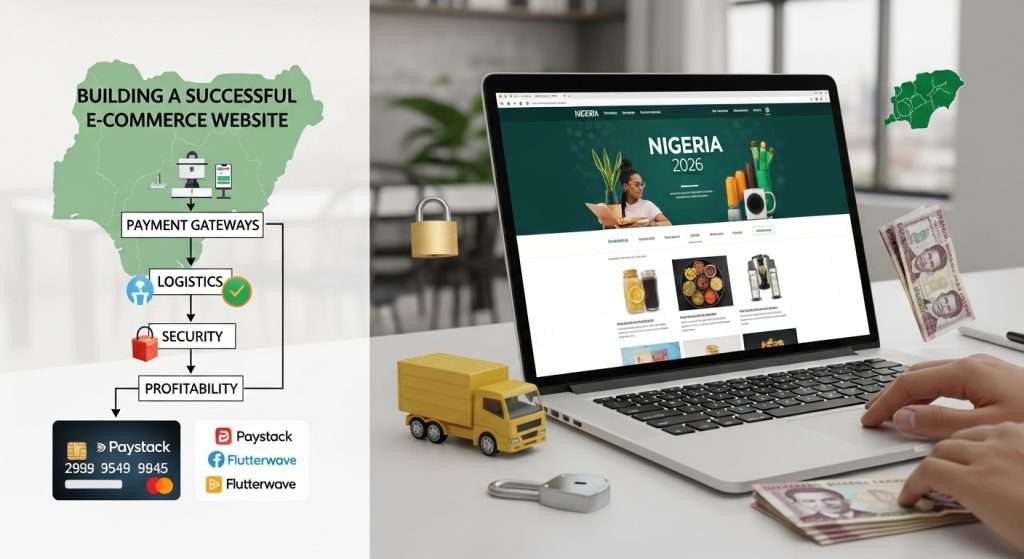
Building an E-Commerce Website in Nigeria 2026: The Complete Guide to Selling Online Successfully
You’ve been selling through Instagram DMs and WhatsApp for months. It works, but you’re exhausted. You’re manually tracking orders in Excel, getting payment confirmations at 2 AM, and spending half your day answering the same questions about shipping and sizes.
You know you need a proper e-commerce website. But you’ve heard the horror stories. Payment gateways that don’t work. Customers who order but never pay. Security issues. Technical problems you can’t solve.
Here’s the truth: Running a successful e-commerce business in Nigeria is harder than in other countries, but it’s absolutely possible. Hundreds of Nigerian businesses are doing it profitably right now.
This guide walks you through everything you need to know to build and run a successful e-commerce website in Nigeria in 2026, from choosing the right platform to handling logistics, payments, and security.
Before you build anything, understand the unique Nigerian e-commerce landscape:
Cash on delivery still dominates. Despite payment gateway improvements, many Nigerian customers still prefer to pay when they receive their items. Your platform needs to handle this.
Trust is everything. Customers won’t send money to a website they don’t trust completely. Your site must scream legitimacy.
Logistics are challenging. Reliable nationwide delivery isn’t as simple as plugging into one service. You need multiple logistics partners and clear processes.
Mobile-first is mandatory. Over 80% of Nigerian online shoppers use mobile phones. Your site must work perfectly on phones or you’ll lose most customers.
Price comparison is intense. Nigerian shoppers check multiple sites before buying. You need to compete on value, not just price.
Return and refund expectations. Customers expect hassle-free returns and refunds. Your policies and processes need to be clear and actually work.
Understanding these realities helps you build for success instead of importing solutions that fail in the Nigerian context.
You have three main options, each with pros and cons:
WooCommerce (WordPress)
Best for: Most Nigerian businesses, especially those wanting full control and customization.
Pros:
– Completely customizable
– You own everything
– Thousands of plugins for any feature
– Works well with Nigerian payment gateways
– One-time cost (no ongoing platform fees)
– Easy to integrate with Nigerian logistics
– Great for SEO
Cons:
– Requires technical knowledge or developer
– You handle security and updates
– Need good hosting
Cost: ₦400,000-₦800,000 setup + ₦100,000-₦250,000 annual hosting/maintenance
Shopify
Best for: Businesses that want simplicity and don’t mind monthly fees.
Pros:
– Very easy to use
– Handles security and updates
– Professional templates
– Reliable hosting included
– 24/7 support
Cons:
– Monthly fees ($29-$299 USD)
– Transaction fees on top of payment gateway fees
– Less customization
– Some Nigerian payment gateways harder to integrate
– You don’t own the platform
Cost: $29-$299/month ($348-$3,588/year) + transaction fees
Jumia/Konga Marketplace
Best for: Testing products without building infrastructure.
Pros:
– Existing customer base
– They handle payment and logistics
– Low setup cost
– Quick to start
Cons:
– High commissions (15-25%)
– Limited branding control
– You’re competing with everyone else
– Customer data belongs to platform
– Difficult to build brand loyalty
Cost: Usually free to list + 15-25% commission per sale
Our recommendation: Start with WooCommerce if you’re serious about building a brand and business. Use marketplaces as additional sales channels, not your main store.
These aren’t optional – they’re requirements for success in Nigeria:
1. Multiple payment options:
– Credit/debit card (via Paystack, Flutterwave)
– Bank transfer
– USSD payment
– Cash on delivery
– Installment payments (if possible)
2. Mobile-optimized design:
– Loads fast on 3G/4G
– Easy navigation on small screens
– Simple checkout process
– Click-to-call and WhatsApp buttons
3. Detailed product information:
– Multiple high-quality images (5-10 per product)
– Detailed descriptions
– Size charts and guides
– Available colors/variants
– Stock availability
– Delivery time estimates
4. Customer reviews and ratings:
Nigerian shoppers rely heavily on reviews. Make them prominent.
5. Live chat or WhatsApp integration:
Customers want immediate answers before buying.
6. Clear shipping information:
– Shipping costs by location
– Delivery timeframes
– Tracking capability
– Delivery areas covered
7. Easy returns and refund policy:
Clear, simple policy visible before checkout.
8. Security features:
– SSL certificate (the padlock)
– Secure payment processing
– Privacy policy
– Terms and conditions
9. Order tracking:
Customers should easily check order status.
10. Abandoned cart recovery:
Email/SMS to customers who didn’t complete checkout.
Payment processing can make or break your e-commerce business in Nigeria.
Top payment gateways for Nigerian e-commerce:
Paystack
Pros:
– Excellent Nigerian bank integration
– Good documentation
– Lower failure rates
– Accepts all Nigerian cards
– Multiple payment options (card, bank, USSD)
Cons:
– 1.5% + ₦100 per transaction
– Some banks still have issues occasionally
Best for: Most Nigerian e-commerce businesses
Flutterwave
Pros:
– International payment acceptance
– Multiple African countries
– Good API documentation
– Accepts cards, bank transfers, mobile money
Cons:
– 1.4% + ₦100 per transaction
– Occasionally higher failure rates than Paystack
Best for: Businesses selling across Africa or internationally
Remita
Pros:
– Strong with government payments
– Good bank integration
– Supports USSD and transfers
Cons:
– Higher fees (2-3%)
– Interface less modern
Best for: Businesses dealing with government or large corporations
Our recommendation: Integrate both Paystack and Flutterwave. Give customers options, and you’ll have backup when one has technical issues.
Critical implementation tips:
Test extensively before launch. Use test mode to complete hundreds of fake transactions. Test every card type, bank transfer, USSD.
Handle failed payments gracefully. Show clear error messages and alternative payment options immediately.
Send instant payment confirmations. Customers should receive email/SMS within seconds of successful payment.
Have backup plan for gateway downtime. When one gateway is down (it happens), you need manual payment processes ready.
Logistics is often harder than building the actual website. Here’s how to navigate it:
Partner with multiple logistics providers:
Don’t rely on one. Have 3-4 options:
National coverage:
– GIG Logistics
– DHL Nigeria
– Red Star Express
– Courier Plus
Lagos-focused:
– Uber (dispatch within Lagos)
– Bolt (dispatch within Lagos)
– Local dispatch riders
Why multiple partners:
– Different strengths (speed vs. cost vs. coverage)
– Backup when one fails
– Better rates through competition
– Different services for different products
Logistics setup checklist:
1. Negotiate rates: Get quotes from multiple providers, negotiate bulk rates.
2. Integration: Integrate tracking into your website so customers can see real-time updates.
3. Clear policies: Define shipping costs, delivery times, and areas covered clearly on your site.
4. Packaging standards: Invest in good packaging to reduce damage and returns.
5. Insurance: For high-value items, insure shipments.
6. Returns logistics: Have clear process for customers to return items.
Nigerian customers are skeptical of online stores. You must proactively build trust:
Visual trust signals:
Professional design: Amateur design = scam in customers’ minds.
SSL certificate: The padlock in the browser address bar.
Contact information: Real phone numbers, physical address, email. Make them prominent.
About page: Show your team, tell your story, prove you’re real.
Social proof: Customer reviews, testimonials, social media proof.
Trust badges: Payment provider logos, security badges, associations you belong to.
Content trust builders:
Active blog: Regular content shows you’re an active, legitimate business.
Social media presence: Active Instagram, Facebook with real engagement.
Customer service responsiveness: Reply quickly to questions and comments.
Transparent policies: Clear return, refund, and shipping policies.
Real photos: Use actual product photos, not stock images (when possible).
Operational trust builders:
Fast communication: Respond to inquiries within 2 hours during business hours.
Order updates: Proactively update customers on order status.
Delivery confirmations: Confirm receipt and ask for feedback.
Handle complaints well: Problems are opportunities to prove you’re trustworthy.
Getting pricing right is critical in price-sensitive Nigerian market:
Factors to consider:
Product cost: Your cost to acquire or produce the product.
Logistics cost: Shipping to customer, packaging, handling.
Payment gateway fees: 1.4-1.5% plus ₦100 per transaction.
Returns and refunds: Budget for some percentage of returns.
Marketing costs: Customer acquisition cost.
Profit margin: Your actual profit after all costs.
Common pricing mistakes:
1. Pricing too low: Trying to compete purely on price destroys your business. Compete on value.
2. Hidden costs: Surprising customers with high shipping at checkout causes cart abandonment.
3. No minimum order: Small orders with high shipping cost percentage aren’t profitable.
4. Ignoring competitor pricing: You need to know what others charge.
Smart pricing strategies:
Free shipping threshold: “Free shipping on orders over ₦10,000” encourages larger orders.
Bundle deals: “Buy 3, get 20% off” increases average order value.
Location-based shipping: Charge less for Lagos, more for Maiduguri (reflects actual costs).
Seasonal pricing: Sales and promotions during slow periods.
Building the site is 30% of the work. Getting customers is 70%.
Essential marketing channels:
Instagram:
– Product photos and videos
– Stories with behind-the-scenes
– Influencer partnerships
– Instagram Shopping integration
– User-generated content
Facebook:
– Business page with shop integration
– Facebook Ads targeting Nigerian audience
– Facebook Groups participation
– Community building
WhatsApp Business:
– Catalog integration
– Quick customer service
– Order confirmation and updates
– Promotional broadcasts (don’t spam)
Google:
– Google Shopping ads
– Search ads for product keywords
– Google My Business
– YouTube product videos
Email marketing:
– Build email list from day one
– Abandoned cart emails
– New product announcements
– Special offers for subscribers
Content marketing:
– Blog posts about your products/industry
– How-to guides
– Style guides
– Customer stories
Launch strategy:
Pre-launch (2-4 weeks before):
– Build social media following
– Create anticipation with teasers
– Offer early bird discount
– Collect emails for launch day
Launch week:
– Special launch discount
– Heavy social media push
– Influencer partnerships activated
– Email blast to pre-launch list
Post-launch:
– Consistent content calendar
– Paid advertising (start small)
– Customer reviews showcase
– Referral program
Conclusion
Ready to Launch Your E-Commerce Business?
Building a successful e-commerce business in Nigeria isn’t easy, but it’s possible with the right strategy, systems, and support.
At Best Brand Tech, we’ve built dozens of successful e-commerce websites for Nigerian businesses. We understand the unique challenges and have proven solutions.
Our e-commerce setup includes:
– Complete WooCommerce development
– Nigerian payment gateway integration
– Mobile-optimized design
– Security and performance optimization
– Inventory management setup
– Training and documentation
– Ongoing support
Contact us to discuss your e-commerce project:
– Call: 08076408835
– WhatsApp: https://wa.link/1yspmi
– Email: support@bestbrandtech.com
Stop dreaming about online sales. Let’s build the e-commerce store that takes your business to the next level.
– E-Commerce Website Development https://bestbrandtech.com/website-design-custom-development
– Payment Gateway Integration https://bestbrandtech.com/website-design-custom-development/
– SEO for E-Commerce https://bestbrandtech.com/seo-local-seo-services

Website Design | Grahics Design | Search Engine Optimization | Business Registration (CAC) | IT Support